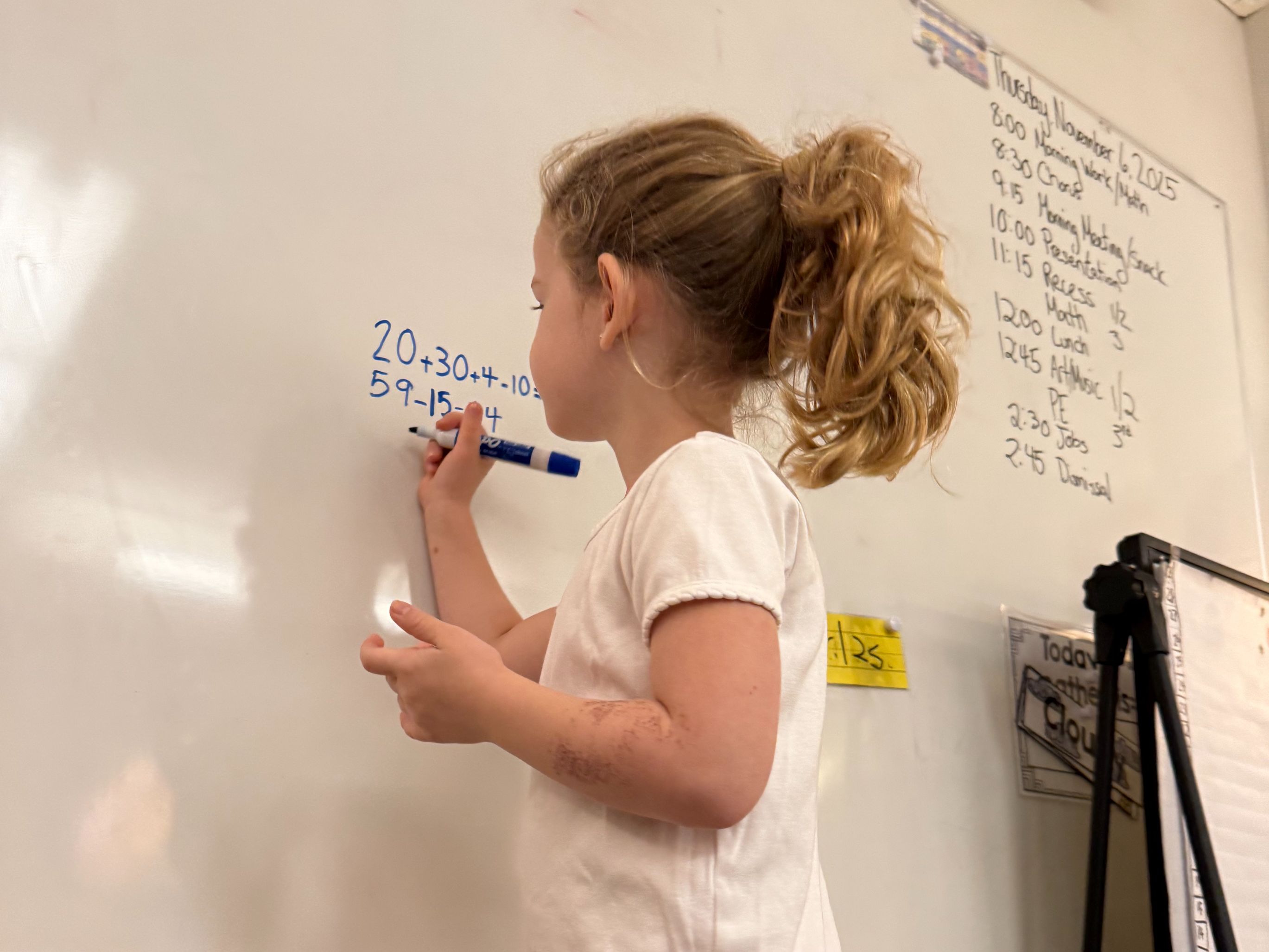
Kim Barrett responds to a few common questions about Montessori math.
There are always a few misconceptions floating around about Montessori math. We asked Kingsley’s Director of Early Childhood Education, Kim Barrett, to dispel the myths and tell us more about this key academic area.
I see students using beads and blocks. Is Montessori math rigorous enough for my child?
Some parents worry that Montessori math seems too easy because it begins with hands-on materials. In reality, these materials are carefully designed to make abstract concepts concrete, allowing children to explore numbers, operations, and geometric ideas in ways they can truly understand. What looks simple often involves complex thinking.
Children work with place value, multiplication and division, fractions, and early algebraic concepts, all while developing reasoning and problem-solving skills. By starting with concrete experiences, children build a deep conceptual foundation that makes later abstract work clear and meaningful.
Hands-on math also supports children in progressing at their own pace. They can revisit and extend concepts as needed, developing confidence and independence while exploring challenging ideas. This approach encourages critical thinking and a genuine understanding of the “why” behind the math, rather than memorizing facts. Montessori math is rigorous, engaging, and designed to foster both competence and a lasting love of learning.
If children can choose their own works, are they getting enough math practice during the day?
While children do have the freedom to choose their own work, they still receive plenty of meaningful math practice. Teachers carefully observe each child, noting their interests, strengths, and readiness, and introduce new lessons at the right moment to support growth.
Children are encouraged to engage regularly with math materials, exploring concepts hands-on in ways that make sense to them. This self-directed practice, combined with thoughtful teacher guidance, helps children build both confidence and competence in mathematics. In addition, our Kindergarten students use daily planners that include dedicated math work each day, ensuring consistent practice and steady progress.
Through this combination of choice, guidance, and structured practice, children develop a deep understanding of numbers, operations, and problem-solving strategies that prepare them for future learning.
What about Practical Life and watering plants? Doesn’t that take time away from math?
Believe it or not, Practical Life works include essential pre-math skills! Before a student can count beads, they must first practice moving their bodies carefully, understand a sequence, develop concentration, and build their vocabulary.
Our Montessori math program is highly rigorous, offering a clear sequence of materials that builds a deep understanding of number sense, place value, and operations. Practical Life develops the motor control, concentration, and independence that allow children to progress in math with confidence and purpose.
Note: If you do have specific questions about your child’s choices in the classroom, I encourage you to connect with their teachers!
Should I be practicing advanced math with my child? Will their skills be stronger if we start complex math lessons in the Early Childhood years?
Sensitive periods matter. During these remarkable windows of development, when the right experiences are offered at the right time, children absorb skills with ease and joy. The Montessori approach builds the mathematical mind by first nurturing order, concentration, and sequencing, the skills children need before moving on to more complex ideas.
Once children reach the sensitive period for logical reasoning and symbolic abstraction, they are ready to engage with operations in a meaningful way. Starting division earlier, for example, doesn’t automatically lead to stronger skills. Our goal is for children to deeply understand math, not just memorize it.
Additionally, pushing children to reach certain math “milestones” before they are developmentally ready can lead to pressure, worry, or avoidance. I highly recommend this article from Granada International Montessori School about how the Montessori approach protects students from math anxiety. When we center joy, satisfaction, and a growth mindset in Early Childhood, we lay a foundation for a positive attitude and self-concept around math for years to come.
Will my child be prepared for math work at a more traditional school?
A question we often hear from families is whether Montessori math prepares children for what they’ll encounter in more traditional school settings. The answer is a confident yes. Montessori math isn’t a different path; it’s a thoughtful, developmentally-informed approach that leads children to the same academic goals, often with deeper understanding and greater joy.
Our math program is designed to build deep understanding. As children transition from hands-on materials to abstract paper-and-pencil work, they don’t just know the steps of an algorithm; they understand why those steps work. This strong foundation supports flexible thinking, problem-solving, and a confident transition to any traditional classroom.
Furthermore, Kingsley’s Elementary math program has been specifically developed to weave together the Montessori math foundation with cutting-edge, evidence-based approaches. Students who stay at Kingsley until Sixth Grade matriculate to highly competitive middle and high schools in the Boston area, and they thrive there. We believe strongly that for ages 2 to 12, Kingsley’s tailored blend of Montessori math and modern practices is second to none.
MEET THE WRITER:
Kim Barrett is Kingsley's Director of Early Childhood. She has a Master’s in Early Childhood Education from Lesley University and over 20 years of experience in early childhood education and nonprofit leadership. She has an exceptional knowledge of early childhood development, strong supervisory skills to support the growth of teachers, and a successful history of fostering a positive school culture.
.jpg&command_2=resize&height_2=85 "The Kingsley Entry Program: KEP 1 & KEP 2")

.jpg&command_2=resize&height_2=85 "Paying It Forward as an Admissions Volunteer")


.jpg&command_2=resize&height_2=85 "Supporting Your Child's Creativity")







.jpg&command_2=resize&height_2=85 "Qs with the HoS: June 2025")